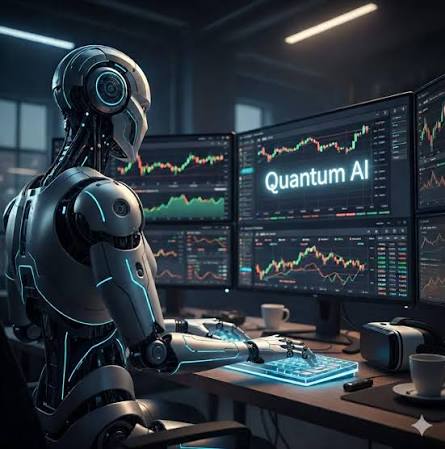

Picture the trading floor of a major stock exchange thirty or forty years ago. The room was defined by noise, physical movement, paper tickets, and hand signals. Managing financial assets relied on human intuition, fast talking, and physical endurance. Today, the reality of market participation looks completely different. The chaotic floors have been replaced by silent data centers filled with rows of servers. Human instinct has been augmented or entirely replaced by mathematical models and algorithmic execution.
Software now dictates the pace of global finance. Algorithms handle everything from basic portfolio rebalancing to complex arbitrage across international borders. As technology improves, the barrier to entry drops. This shift has altered how massive institutions handle their capital and completely redefined the tools available to individual investors. Understanding how computers have taken over the heavy lifting is completely necessary for anyone looking to participate in modern financial markets.
The Shift Toward Machine Precision
Trading relies on information processing and reaction time. The human brain is incredibly good at recognizing long-term patterns or shifting narratives, but it is fundamentally terrible at high-frequency data calculation. A person needs hundreds of milliseconds just to register a visual cue on a screen and click a mouse. By the time a physical finger clicks a button to execute a trade, a computer program could have processed thousands of data points, evaluated multiple risk parameters, and executed hundreds of independent orders.
Speed is just one part of the equation. Human beings get tired. We lose focus after staring at charts for three hours. We hesitate when we feel nervous, and we rush into decisions when we feel overconfident. Computers do not suffer from fatigue, fear, or greed. A well-constructed algorithm simply follows the instructions written into its code. It evaluates the numerical data presented by the exchange and triggers a response the exact millisecond the required conditions are met.
This precision allows participants to capture very small price movements that a normal person would miss. A human trader might try to catch a dollar movement over the course of a day. A machine might try to catch a fraction of a cent across ten thousand transactions in five minutes. The cumulative effect of these micro-transactions builds a distinct advantage over manual buying and selling.
Operating in a Market That Never Sleeps
For over a century, traditional stock markets operated on a fixed schedule. The opening bell rang in the morning, and the closing bell rang in the late afternoon. Traders went home. The weekend provided a mandatory rest period for the entire industry. If macroeconomic news broke on a Sunday, the market digested that information and reacted when the bell rang on Monday morning.
Cryptocurrency completely destroyed that schedule. Digital assets trade twenty-four hours a day, seven days a week, three hundred and sixty-five days a year. There are no holidays. There are no closing bells. A market moving event can happen at three in the morning just as easily as it can happen at noon.
This continuous schedule creates an impossible physical demand for human operators. You cannot watch a screen all night without eventually making a critical mistake. If you go to sleep holding a highly volatile digital asset, a major price correction could happen while you are entirely unable to react. Software solves this scheduling problem. A program monitors the price action constantly. It acts as an untiring guard duty, ready to execute protective selling or opportunistic buying at any hour of the night.
Unpacking the Technology Wars
The foundation of this shift relies on massive upgrades in computing horsepower and data ingestion capabilities. Initially, automated strategies were simple. A programmer would tell the system to buy when a short-term moving average crossed above a long-term moving average. If the lines crossed, the software bought the asset. If they crossed back, it sold. These systems were rigid and heavily reliant on clear trends.
Current architecture goes far beyond those simple technical indicators. Modern systems ingest news headlines, social media sentiment, blockchain activity, and order book depth all at the exact same time. The goal is to evaluate the market from every possible angle simultaneously. Artificial intelligence and machine learning models process this incoming data to recognize subtle correlations that a human analyst could never spot by eye.
We are now seeing the introduction of concepts drawn from advanced academic research to find better entry and exit points. Systems process multiple variable outcomes to calculate the absolute most statistically favorable path forward. For traders who want to participate in this highly technical environment without building their own software from scratch, specialized tools provide the necessary infrastructure. A platform utilizing Quantum AI automated trading helps filter through the noise to identify mathematically sound opportunities at a speed humans cannot replicate. These systems level the playing field by providing the computational muscle required to process global data feeds in real time.
Moving Away from the Hedge Fund Monopoly
Fifteen years ago, algorithmic trading was restricted to the most elite financial institutions in the world. Firms spent tens of millions of dollars to gain physical proximity to stock exchange servers just to cut a few microseconds off their communication lag. They hired armies of dedicated mathematicians, commonly called quants, to write proprietary code.
The individual retail participant was left completely behind. An everyday person trading from a home computer had no chance of competing against billion-dollar server farms.
The spread of cloud computing and open application programming interfaces changed the power dynamic. Financial exchanges began offering public API access, allowing any approved user to connect external software directly to their account. Cloud service providers made massive computing power available to rent by the hour. A smart developer in a small apartment could suddenly access the same basic raw materials that Wall Street firms used.
Today, the software layer has become even easier to use. Participants do not even need to write their own Python scripts. Intuitive graphical interfaces allow a user to define their risk tolerance, choose a specific strategy, allocate a percentage of their portfolio, and click start. The complex mathematics and server communication happen entirely in the background.
Managing Risk Without Emotional Interference
Ask any veteran trader what causes the most damage to a portfolio, and they will almost always answer with human psychology. People attach their ego to their financial decisions.
When an asset drops sharply in value, the logical move is often to cut the loss early and protect the remaining capital. A human trader, however, feels the sting of admission. Recognizing a loss means admitting you were wrong. People often hold onto falling assets, hoping the market will turn around and validate their original thesis. This behavior causes minor mistakes to transform into catastrophic portfolio damage.
Conversely, when an asset rises quickly, people experience extreme fear of missing out. They buy in at the absolute peak of the price movement, driven entirely by the herd mentality displayed on social media.
Software removes the ego from the equation entirely. An automated system requires strict mathematical parameters for risk management. Before a trade even begins, the system registers a hard stop-loss limit and a rigid take-profit target. If the asset drops five percent, the system executes a sale without hesitation, without hope, and without regret. Protecting capital becomes an automated reflex rather than a difficult emotional judgment call.
Real-World Applications and Tactics
To understand exactly how these systems function, we have to examine the specific methods they deploy. Algorithms do not just randomly buy and sell. They operate on highly defined strategic logic.
Statistical Arbitrage
The most famous automated strategy involves finding pricing inefficiencies between different marketplaces. A specific cryptocurrency might trade for a fraction of a cent more on a European exchange than it does on an American exchange. A physical person cannot switch between two websites and execute trades fast enough to capture that fraction. A software program can buy the cheaper asset and sell the more expensive asset simultaneously. The profit margins are incredibly thin, but the algorithm repeats the process thousands of times a day to generate meaningful returns.
Mean Reversion
Markets tend to stretch like rubber bands. When a price moves too far and too fast in one direction, statistical probability suggests it will eventually snap back to its historical average. Machines calculate the exact standard deviation of a given asset over time. When the current price violates that mathematical boundary, the system takes a position betting on the eventual return to normalcy.
Sentiment Analysis
Modern natural language processing allows algorithms to read written text. Systems can ingest thousands of financial news articles and social media posts every second. They scan for specific keywords, gauge the positive or negative tone of the text, and instantly predict how human traders will react to the news. If a major regulatory body announces an investigation into an asset, the software reads the headline and dumps the position seconds before the human market can even finish reading the first paragraph.
The Importance of Historical Testing
The ability to connect a powerful machine to a brokerage account is useless without proof that the strategy actually works. The biggest advantage of mathematical trading is the ability to run simulations against historical data. This process is called backtesting.
If you have a brilliant idea for a new buying rule, you do not have to risk your actual money to test it. A user can apply their new algorithm to the market data from the years 2018 through 2022. The computer simulates exactly how the algorithm would have performed during bull markets, bear markets, and completely unexpected flash crashes.
Backtesting reveals the maximum drawdown, the win rate, and the exact risk profile of a strategy before a single live order goes into the market. This creates a scientific approach to personal finance. However, operators must avoid the trap of curve fitting. Changing the code until it performs perfectly in the past does not mean it will perform perfectly in the future. The market is organic and constantly changing. Successful systems adapt to new conditions rather than relying purely on historical perfection.